|
The Far East was captured in a dramatic attempt by Japan to seize its wealth of natural resources, the captured men, woman and children had to endure nearly four years of Japanese oppression.
The prisoners lived their captivity as an endless nightmare and with no hope many died of despair.
The fortunate to awaken from their ordeal were never the same again. The nightmares returned to haunt their sleep and the faces of those left behind have never left them.
Researching their ordeal to find answers has led many of us to experience their torment, we will never feel the pain they endured and fortunately we can awaken from the despair that became their living hell as Japanese Pow’s.
All the articles within the FEPOW Community are written to help the FEPOW cause and are not ‘Public Domain’.
Permission must be obtained before their use.
The FEPOW Family
The FEPOW Family now has a Facebook Group - https://www.facebook.com/groups/1248087371902974/
Roll of Honour
The roll of honour has taken much of my time this last few years. It has developed into much more then I initially sought back in the early 1990s. Every British death in the Far East during WWII is included and has been expanded to include many of our Allies. The late Roger Mansell sent me loads of rolls from Japanese Homeland Camps which were compiled by Wes Injerd. Now I am getting over illness I am including these as well. There is a ‘Search’ facility to find names easier but it does take about 4 weeks for new entries to be spidered by Google. Loved ones can be included, so please email me with their details and a photo if possible.
Web Site is at www.roll-of-honour.org.uk
The Secret Art of Survival Exhibition
Liverpool 2019-2020
This exhibition is the result of a study undertaken by the Liverpool School of Tropical Medicine (LSTM). In partnership with the University of Liverpool’s Victoria Gallery and Museum (VG&M), LSTM is organising this major new public exhibition which will run from late autumn 2019 to June 2020, the 75th anniversary year of the ending of WWII.
Over the past five years, Prof Geoff Gill and Meg Parkes have been researching the range of the secret FEPOW British military art work created during captivity: watercolours, pencil sketches, crayon drawings, portraiture, cartoons and caricatures, landscapes, flora and fauna, disability, disease and death, maps, camp plans etc. They’re all art, secretly created and kept hidden at great personal risk and eventually returned to this country.
To date we have identified and located the art of 37 British servicemen whose work forms an extraordinary archive of “documentary” contemporaneous art.
Aspects of survival featuring in the exhibition will include, the medical and psychological battle to survive, as well as the environmental: huts, camps, facilities, geography. From the Tropics to the most northerly and southerly regions, from west to east, artists were secretly recording what was happening to, and around, them in captivity.
There are six or seven well-known British FEPOW artists including, Jack Chalker, Ronald Searle, Leo Rawlings and Philip Meninsky, whose work has been exhibited and published during the post-war years. Examples of their work will be included in the exhibition.
But the main aim is to shine a spotlight on the many anonymous, unknown and rarely seen works, created by a host of British servicemen, both amateur and professionally-trained artists, who took extraordinary risks to capture aspects of survival in Far East captivity, recording what they saw and what they wanted the viewer to see. Much of this work has been hidden away in boxes, files, envelopes for decades, sometimes only discovered after the artist has died.
It must be seen. And now it will be. There is so much to learn from what they painted and sketched.
Appeal
We are still “finding” art work from captivity and the number of artists continues to grow. We would be delighted to hear from anyone who has examples of art work created in captivity that they would like us to know about.
We would also like to hear from anyone who intends to visit the exhibition during the run; this will help us in support of our applications for funding.
Example
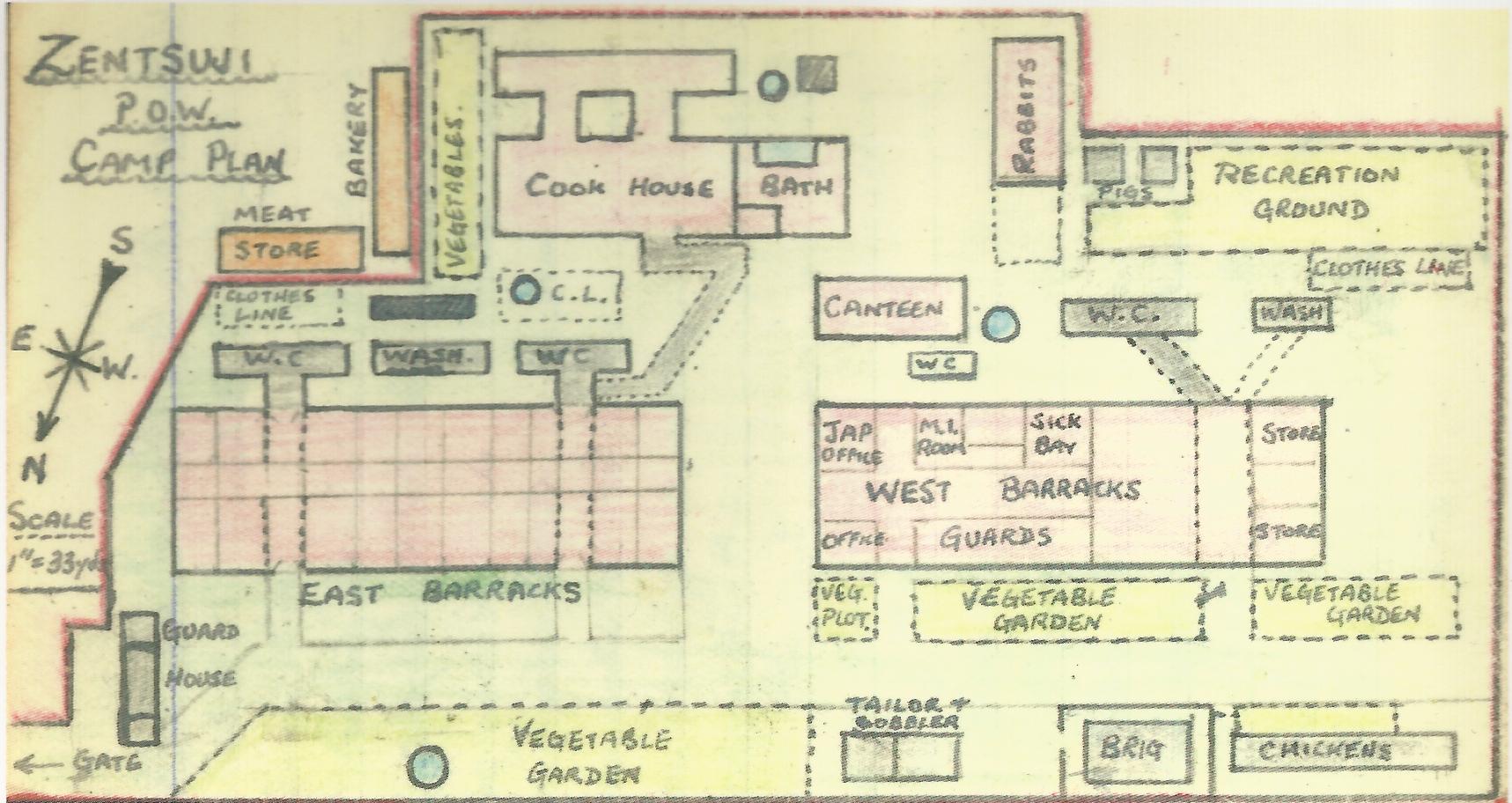
An illustration, done by my father, Capt A A Duncan, A&SH in Zentsuji POW camp on the island of Shikoku in 1944. It has been drawn to scale and has compass bearings. If he’d been found with this and the other camp plans he drew. I doubt I’d be writing this to you now!
Contact: Meg Parkes… meg.parkes@lstmed.ac.uk
www.captivememories.org.uk
Remembrance Day - 11th November 2015
Louise Reynolds laid wreaths at the Singapore Memorial on behalf of the FEPOW Family and her father Eric Cordingly, who was POW Chaplain in the Far East 1942-45. Louise was also invited to lay a wreath at the Singapore Cenotaph on Remembrance Day, she told me, “I felt very honoured to place it on behalf of the FEPOW Community”.
Louise will be giving a talk at the ‘Time and Tide Museum’ , Great Yarmouth on Friday 4th December at 11.30am, this is a ticket event.
*****
Avril Anderson sent me photos of the Remembrance Service at East Kilbride, Scotland. She laid a wreath on behalf of the FEPOW Family
A wet and blustery Remembrance Service at East Kilbride War Memorial but a very good turn out.
VJ Day (FEPOW Day) Commemorations
Page covering events is at - http://www.fepow-day.org/html/2015.htm
In Remembrance for FEPOW Day - August 15th
Ron Taylor’s Bolo
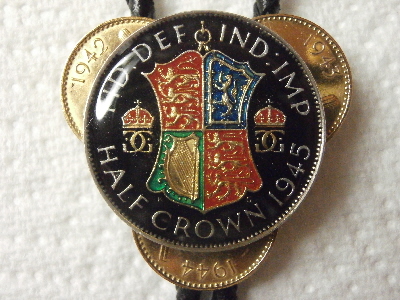 The bolo (Boot Lace Tie) was made in remembrance of my father. The farthings as background represent:- The bolo (Boot Lace Tie) was made in remembrance of my father. The farthings as background represent:-
1942 - Captured Singapore
1943 -Working on the Thailand-Burma Railway
1944 - Transported back to Singapore
1945 Half Crown - Transported to French Indo China (Vietnam), liberated 15th August.
Mira Harpham’s Wall Hangings
My wife, Mari, has produced 2 textile wall-hangings in memory of my Father and all FEPOW's that endured captivity and under the Japanese and for those who worked on the Burma/Siam railway.
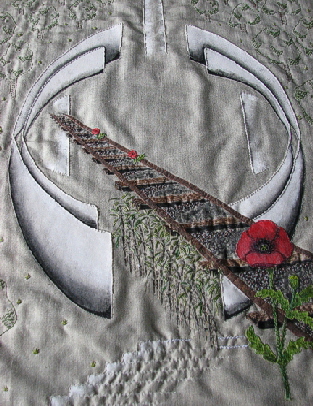 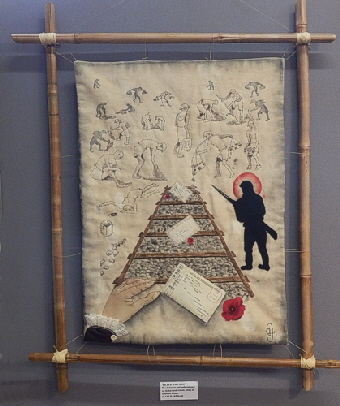
By Andrew Harpham
Thank you Mira, they are sad but also very beautiful - Ron
Walking In Their Steps
These articles contain many photos of places our loved ones walked whilst PoWs.
Hellfire Memorial - Erected in 2005
Ian’s Visit To Thialand by Ian Whyte
Songkurai by Patricia de Tisi
Thailand Trip by Keith Andrews and Mike Nellis
Please click on the titles above to view
Looking Back
The Fall of Singapore 70 Years On
From the Lanarkshire Yeomanry Group Newsletter on the recent Service of Remembrance at Newmains.
It includes the moving address given by the Rev. Paul Grant of St. Ninian's Parish Church, Stonehouse.
Please click on the links below
Page 1
Page 2
Page 3
Address by Rev. Paul Grant
Submitted by Agnes Dougan
(The files above are in pdf format and will take a while to download)
Researching
Need help in researching, you will find helpful hints within these pages, A Start to Researching . As the years pass by many a descendant of these brave souls has researched those prisoner of war years. There are tools to help with the Fepow Story, Books, internet and the Fepows themselves. The Fepow Community has now added new tools for research purposes, the main research section being The Rising Sun . Translation of the Japanese words used by the prisoners is covered by the Word Translator , this started as a pamphlet given to the prisoners by the Japanese and has been enlarged upon. The Fepow Verse has been gathered together by the late Maurice Rooney. One of the ways to survive the prisoners ordeal was to turn to Religion, all prisoners beliefs are respected. The latest addition is the Abbreviations section, I was asked what ALSEA was, I thought life would be easier for us all with the forces abbreviations on.
Web Site Updates
After an email I believe it is advisable to advise browsers:-
- This is not an organisation
- The old FEPOW organisation is no more
- The FEPOW sites are written in my own time
- The Roll of Honour has taken priority since the 65th anniversary of liberty
- Being a one man band, I try my best, but it is impossible to cover all aspects of POW life
- Please use the Research section if extended research is required
- If you have written pages which will help others please email the link
- Otherwise please do not criticise, it doesn’t help
- It has taken about 22 years to put together information to help others, in my spare time
- Thanks to all those who have emailed with appreciation, it does means a lot
- All the sites I have written are in remembrance of those who lost their lives in the Far East
- Everything is free except the pins , any profit from these pays for wreaths
- It has cost a lot of time and money but is worth it for the FEPOW’s and my own fathers remembrance
Having gone through my childhood as a child of a FEPOW, I believe there is depth in my writings. I can not try to capture the horror of those years in the camps, but in the 1960’s my father gave me his diary to read, home life then began to make sense, screams in the night followed by shadowy footsteps, everything had to be eaten on ones plate, cloths were worn till they could not be any more, life was strange but my dad was there and will always be my hero.
Keep the candle burning, they deserve it !
Background Music
The Naked Isle is written and sung by Jim Rowlands in remembrance of his grandfather Albert Owen Rowlands from the 600 gunners party. The Japanese reported that the ship carrying the prisoners was lost at sea after leaving Singapore, which is known as the Naked Isle.
It wasn’t till after the war the truth was found when a large mass grave was found on Ballali Island, the Japanese had used 517 of the fittest to construct a runway on Ballali Island leaving the sick at Rabaul, then when finished those of the 517 remaining alive were massacred by the Japanese.
436 bodies were exhumed on Ballali Island, those remaining of the 517 are believed to have died before the massacre and buried on the island.
The date of death given by the Commonwealth War Graves is the 5th March 1943 for those who died on Ballali Island, the correct date is not known.
Fepow Day Pin:-
To promote August 15th as Fepow Remembrance Day a pin is also being produced.
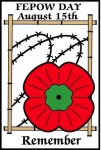
The pin will be 1 inch high in Fine Enamel with a butterfly clutch.
The estimated cost will be £1.50 + postage.
Please order via the printable form:- Order Form
If you require help please email Ron at:- Ronnie.Taylor@fepow.family
I would like to thank Michael Hurst MBE for all the help he has given with this project.
New Books:-
Can now be found under Books
|